Many property owners are sitting on more potential than they realise. A generous backyard, a corner block, an older house on a large lot — in the right location, these can be the starting point for a boutique residential development. But a big block doesn't automatically mean developable, and developable doesn't always mean worth developing. Here's how to think about it.
What makes a site developable?
The first question is what the planning framework allows. A handful of factors do most of the heavy lifting:
- Zoning — your land's zone sets the baseline for what's permissible: single dwellings, dual occupancies, multi-dwelling housing, and so on.
- Land size, frontage and depth — councils set minimums for subdivision and multi-dwelling development. A wide frontage and useable depth open up far more options than a narrow or awkward block.
- Access and orientation — how the site is accessed, whether a corner or battle-axe arrangement is possible, plus slope and aspect, all shape what can realistically be built.
The controls that decide what you can build
Beyond zoning, a set of development standards govern the building envelope: floor space ratio, height limits, minimum lot size, setbacks and site coverage. Together these determine how much a site can carry and in what form. Two similar-looking blocks in different zones — or even different streets — can have very different potential.
The constraints that catch people out
This is where good due diligence earns its keep. Overlays and site conditions can quietly reduce a project's potential:
- Heritage, flood, bushfire or environmental overlays
- Easements and services — stormwater, sewer, power — crossing the site
- Significant slope, difficult access or established trees
- Infrastructure and developer contribution requirements
None of these are necessarily deal-breakers — but each needs to be identified early, before assumptions are baked into a plan or a purchase price.
Developable versus feasible — the crucial difference
A site can be technically developable and still not stack up. Feasibility is where planning potential meets commercial reality: land, construction, fees, finance, holding costs and contingency on one side; realistic end values on the other. A project only makes sense when the numbers work on conservative assumptions — not best-case guesses.
How Studio 72 assesses your site
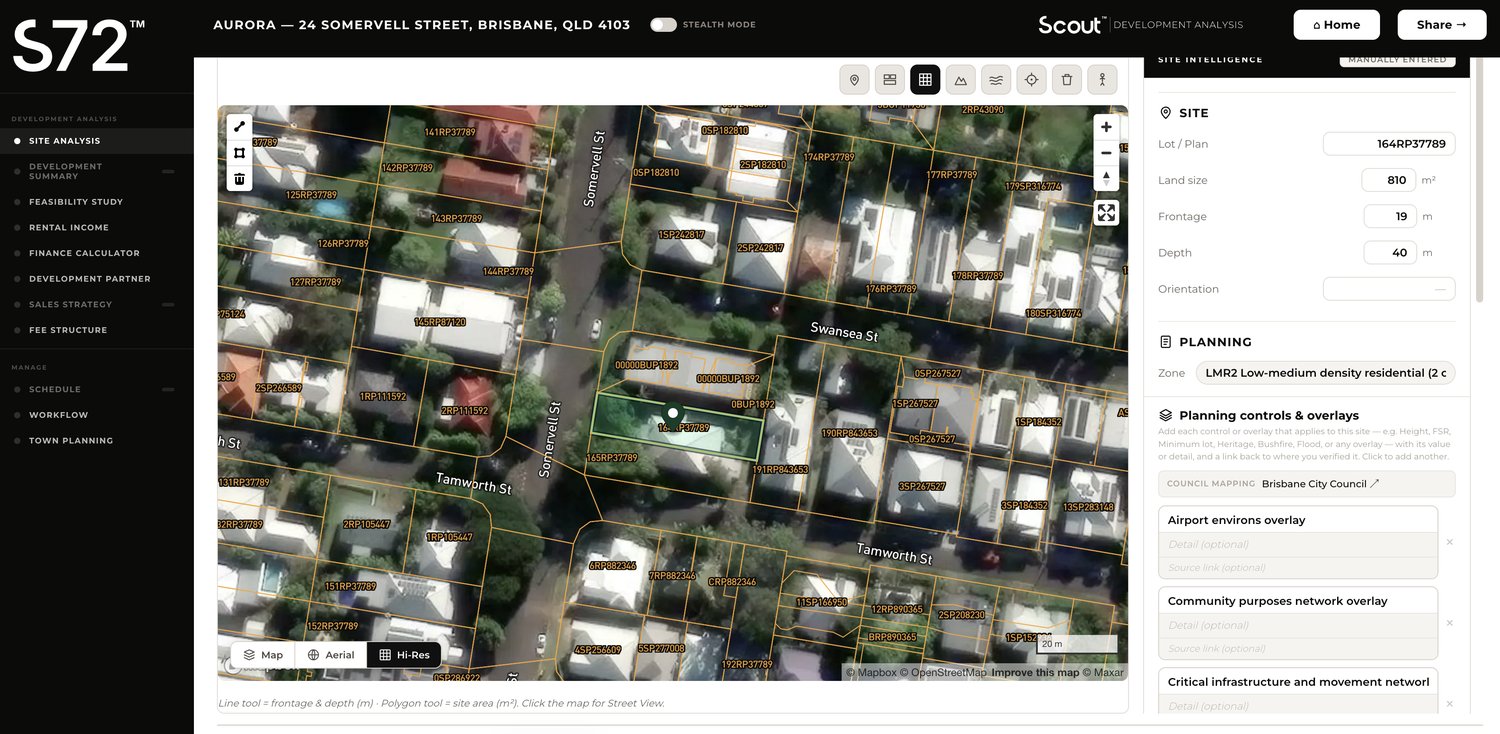
We take the guesswork out of it. Every site we look at is analysed in Scout™, our own development-analysis platform — verifying zoning, dimensions, overlays and constraints against the authoritative sources, then modelling a full feasibility of costs, yield and end values on conservative, lender-aligned assumptions. You get a clear, honest picture of what your site could become before you commit a dollar.
Once we know what's possible
If the site stacks up, there are two ways forward with Studio 72. You can fund the development yourself as the sole owner, with us managing the whole process end to end — and, where it helps, connecting you with SGB Finance, our development finance partner. Or, for selected projects, you can explore participating alongside us. Either way, it starts with understanding the site.
Frequently asked questions
How do I know if my block can be subdivided?
It depends on your zoning and your council's minimum lot size and frontage requirements. We verify these against the authoritative planning sources in Scout before advising.
Does a bigger block always mean more development potential?
Not always — zoning, overlays, access and shape matter as much as size. A well-located, well-zoned smaller block can outperform a large but constrained one.
Can Studio 72 assess my site's potential?
Yes. We run a full site analysis and feasibility in Scout and give you an honest view of what your site could become before you commit.
This article is general information only and does not constitute planning, legal or financial advice. Every site is different — seek advice specific to your property.